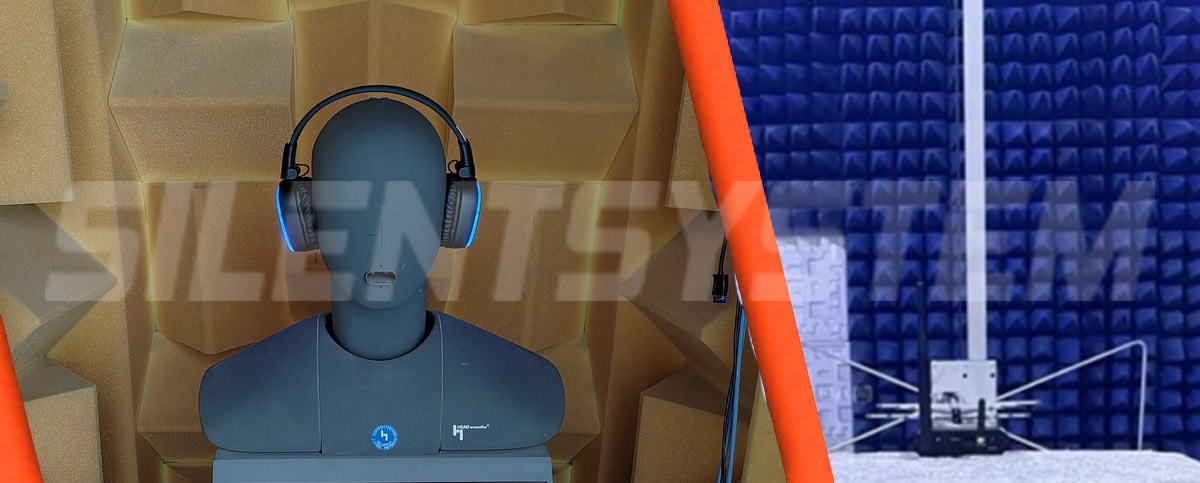
The documentation covers radio frequency, acoustic safety, electromagnetic compatibility and product safety.
What this page covers: a clear, concise overview of the technical standards for RF headphones, wireless transmitters and the related compliance testing that applies to Silentsystem equipment.
Wireless audio equipment for professional use
At events, conferences and silent experiences, signal stability, managing multiple audio channels and serving a large number of users at once are essential. That’s why professional systems use dedicated RF architectures, unlike consumer Bluetooth headphones designed mainly for personal use.
The technical reports for the tested Silentsystem RF headphones and Silentsystem transmitters specify systems operating on three channels in the 863-865 MHz band, with FM modulation. In addition to 3-channel systems, Silentsystem uses multichannel systems in the UHF band, described in the next section.
Practical benefits of a multichannel RF setup:
- multiple audio streams at the same event
- quick, easy channel switching on the headphones
- more flexibility for silent disco, simultaneous interpretation and breakout sessions
- smoother operations when managing the audience
Systems and frequency bands
Silentsystem uses 3-, 10-, 45- and 60-channel systems. For each system we list the operating band; the detailed channel plan is provided to clients during the project phase.
| System | Band | Notes | Headphones |
|---|---|---|---|
| 3 channels | 863-865 MHz | Standard system, the most common configuration for silent disco, guided tours and events | SX-809, SX-808, SX-839, SX-707, RX-705 |
| 10 channels | UHF 640-672 MHz | Multichannel system for conferences, simultaneous interpretation and formats with multiple audio streams | SX-809, SX-839, SX-858, SX-610, RX-705, RX-905 |
| 45 channels | UHF 640-672 MHz | Programmable channels: an event uses a subset, picking the ones free of interference | SX-809 |
| 60 channels | UHF 500-600 MHz and 640-672 MHz | 6 groups of 10 programmable channels: maximum flexibility in choosing clear frequencies | SX-839 |
Why 45 or 60 channels? It’s not about using every channel at the same time: having many programmable channels lets you pick the cleanest frequencies at each venue and switch quickly if interference comes up. An event typically uses only a portion of the available channels.
Standards at a glance
This table summarizes the standards cited in the technical reports described in the sections below.
| Standard | Scope | Devices | Result |
|---|---|---|---|
| ETSI EN 301 357 V2.1.1 | Radio – wireless audio devices (RED Directive 2014/53/EU) | RF headphones and TX series transmitters | Pass |
| EN 62479:2010 · EN 50663:2017 | Human exposure to electromagnetic fields | RF headphones | Pass |
| EN 50332-2:2013 | Maximum sound pressure of personal audio devices | RF headphones | Compliant |
| ETSI EN 301 489-1 / -9 / -17 | Electromagnetic compatibility | Transmitters | Pass |
| EN IEC 62368-1:2020+A11:2020 | Safety of audio/video and ICT equipment | Transmitters | Passed |
| ETSI EN 300 328 V2.2.2 | Bluetooth Low Energy and Classic, 2.4 GHz band | TX-350 CH3 BT | Pass |
Testing on the RF wireless headphones
Silentsystem RF wireless headphones have been tested in three areas: radio, electromagnetic field exposure and acoustic safety.
RF standard
Tested to ETSI EN 301 357 V2.1.1 with a Pass result, as part of radio testing for CE marking under the RED Directive 2014/53/EU. The report lists the test model, the model family, the 863-865 MHz operating band, the three operating channels and the integrated antenna.
This standard covers cordless wireless audio devices and is a key benchmark for assessing proper radio spectrum management in systems intended for professional use.
Electromagnetic fields
Tested to EN 62479:2010 and EN 50663:2017, which cover the assessment of human exposure to electromagnetic fields, with a Pass result. The report lists Silentsystem RF wireless headphones as the product under test and identifies LEM International S.r.l. as the applicant.
This documentation is especially useful for corporate clients, public agencies, organizers and venues that need more in-depth technical information on the safety profile of the equipment.
Acoustic safety
Tested to EN 50332-2:2013, which covers the maximum sound pressure of personal audio devices. The report states that the test items are compliant and references the safeguard limits against acoustic energy sources set by the EN/IEC 62368-1 family.
In a professional system, the listening experience should stay engaging while remaining controlled and in line with good hearing-safety practices.
Recommended best practices: run real audio tests before the event, avoid distorted or overly compressed signals, check that levels are consistent across channels, and give end users clear guidance on adjusting the volume.
Testing on the transmitters
Silentsystem RF wireless transmitters have been tested for electromagnetic compatibility, radio standards and electrical safety; some models also include a Bluetooth function.
Electromagnetic compatibility
Tested to ETSI EN 301 489-1, ETSI EN 301 489-9 and ETSI EN 301 489-17, with a Pass result. The documentation covers electromagnetic compatibility, radiated emissions, conducted emissions and immunity testing.
In practice, electromagnetic compatibility makes the system more reliable in environments shared with other electronic equipment, power supplies, cabling and radio sources.
Radio standard
Silentsystem TX series transmitters have also been tested to ETSI EN 301 357 V2.1.1 with a Pass result, again for the 863-865 MHz operating band and the system’s three channels.
This confirms the technical consistency of the RF platform for professional multichannel wireless audio applications.
Electrical safety
Tested to EN IEC 62368-1:2020+A11:2020, the benchmark standard for the safety of audio/video, ICT and communication technology equipment, with a positive result stated in the report. The document addresses electrical safety, thermal hazards, mechanical hazards, markings and safety instructions.
The report also states that the product meets the requirements of the standard and is classified as transportable equipment for use in dry locations.
Bluetooth function
Some transmitters, such as the TX-350 CH3 BT test model, also include a Bluetooth 5.2 function. The dedicated reports show testing to ETSI EN 300 328 V2.2.2 for both Bluetooth Low Energy and Classic Bluetooth in the 2.4 GHz band, with a Pass result.
This function can serve as an input or an operational aid, but in event systems, audio distribution to large numbers of headphones still relies on the dedicated RF architecture.
Technical approach and operational reliability
When you evaluate professional wireless audio equipment, it’s not just about sending audio to headphones. Signal stability, channel management, the quality of the RF design, compliance with applicable standards and the availability of clear technical documentation all matter too.
That’s why reports covering radio frequency, electromagnetic field exposure, acoustic safety, electromagnetic compatibility and product safety give organizers, agencies, venues, museums, companies and industry professionals a more solid technical foundation.
FAQ on standards and safety
More helpful guides
RF audio systems for events
How wireless audio systems work for events, conferences and installations.
RF vs. Bluetooth vs. Auracast
A comparison of the wireless audio technologies used at events.
RF wireless headphones for events
Headphones for silent disco, conferences, museums, tours, and installations.
All guides
Technology, applications, and standards for wireless event audio systems.
Need the technical documentation?
Contact us for information on standards, compliance and choosing the right equipment. You can also call us at +39 338 155 5535.